Compensation
The third and clinically very important classification of heterophoria is as either compensated or decompensated (Marton 1954). As already stated, heterophoria is a normal condition present in the vast majority of people. It is considered a physiological condition, as in most cases it is not harmful and causes no symptoms. In these circumstances it is described as ‘compensated’. Sometimes, however, there are abnormal stresses on the binocular vision that result in symptoms and the heterophoria is described as being ‘decompensated’. This is more likely to happen if there are developmental abnormalities in the anatomical, motor or sensory systems. These may not in themselves make the phoria decompensated and in very many cases do not. The trigger or catalyst that causes a heterophoria to become decompensated is often a change in the patient’s general or visual conditions. The factors that may bring about such a change are listed in Chapter 4. The first consideration in treatment is to remove as many as possible of these decompensating factors.
Classification of strabismus
As well as deciding whether strabismus or heterotropia is comitant or incomitant, it can be classified according to constancy, eye preference and the direction of deviation. In some patients the angle varies with the accommodative state. Strabismus may also be present for both distance vision and for near vision, or at only one fixation distance. The angle of deviation may also vary with the fixation distance, giving classifications of divergence weakness, convergence excess or basic (mixed) types of convergent strabismus; and convergence weakness, divergent excess or basic types of divergent strabismus. These correspond with the classifications of heterophoria (above). A new system of classification has recently been suggested (Committee for the Classification of Eye Movement Abnormalities and Strabismus 2001), which is generally similar to that described here. It remains to be seen whether some of the new terminology that this committee has suggested will take hold (e.g. replacing ‘Duane’s retraction syndrome’ with ‘co-contractive retraction syndrome’).
Constancy
Strabismus can be classified as either (1) constant or (2) intermittent. It is described as constant if it is present all the time and under all circumstances and intermittent if it is present at some times and not at others. Some cases of strabismus are intermittent in the sense that patients have coordinated binocular vision most of the time but when the visual system or general wellbeing is under stress the strabismus occurs. In these cases, binocular vision does not show the signs of decompensated heterophoria but breaks down into a strabismus. In some cases, an intermittent strabismus will develop into a constant strabismus if left untreated, but in others it remains intermittent. A rare form of intermittent strabismus in which the patient has a large convergent strabismus on alternate days only is referred to as ‘cyclic strabismus’ or ‘alternate day squint’. Costenbader & Mousel (1964) found it to be less than 0.1% of all strabismus. The cyclic strabismus usually becomes constant after a few months.
Right convergent
Left convergent
Right divergent
Left divergent
Right hypertropia
Left hypertropia
Right hypotropia
Left hypotropia
Right excyclotropia
Right incyclotropia
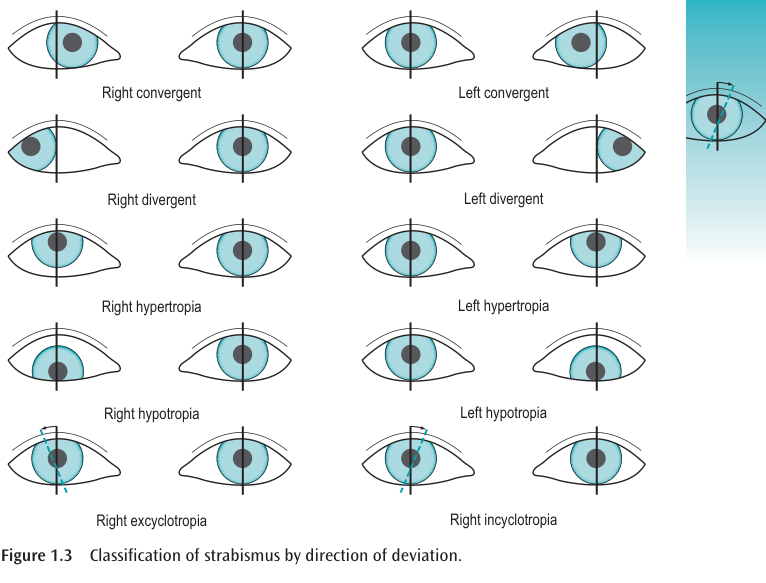
Figure 1.3 Classification of strabismus by direction of deviation.
In the case of intermittent strabismus, it is useful to assess the proportion of time when the strabismus is present. A patient who has binocular vision for most of the time may have a better prognosis.
Direction of deviation
The classification by the direction of the deviation is illustrated in Figure 1.3.
Eye preference
In strabismus, an image of the object of regard will be maintained on the fovea of one eye while the other eye is deviated. Some patients always use the same eye for fixation and others can fixate with either eye. Strabismus then can be classified as (1) unilateral or (2) alternating.
In alternating strabismus, the eye chosen for fixation at any given time can depend on:
Fixation distance. Some patients will use one eye for distance vision and the other for near.
Direction of gaze. In some patients the eye used for fixation will depend on the direction of gaze. In convergent strabismus, this often indicates
a congenital impairment in the abducting function of one or both eyes. The right eye fixates objects in the left of the field, and the left eye in the right; this is known as ‘crossed fixation’.
Vision and refraction. If the vision and the refractive error are equal or nearly equal, the choice of eye for fixation may appear indiscriminate. Some cases of this type are considered to lack the ability to fuse, and these have been called ‘essentially alternating’ (Worth 1903). These are often divergent strabismus and very rarely respond to treatment to establish binocular vision. Some other alternating strabismus will become unilateral if left untreated. In young children this is undesirable because it can result in amblyopia.
Accommodative state
The angle of the strabismus may vary with the amount of accommodation exerted. In hypermetropes this is an important factor in the treatment, so that strabismus may be classified as: (1) fully accommodative, (2) partially accommodative or (3) non-accommodative.
It is estimated that about two-thirds of cases of comitant convergent strabismus have an accommodative element. This means that the angle will be reduced by a refractive correction for hypermetropia; fully in some cases and partially in others. In such cases, the refractive correction forms a major part of the treatment of the deviation.
In about one-third of cases of comitant convergent strabismus, the refractive correction does not change the angle of deviation. These are non-accommodative strabismus. However, some patients who overconverge for near vision have non-accommodative strabismus. In these cases, the convergence excess is not stimulated by the accommodative effort.
Importance of classification
In the clinical assessment of both heterophoria and strabismus, the classification will assist in deciding what can be done to help the patient: the clinical management.
In cases of heterophoria, for example, the most important consideration is whether the deviation is compensated or decompensated (Ch. 4). Compensated heterophoria usually requires no action. The management of esophoria is different from that of exophoria. It will also differ if the heterophoria is present for near vision, as accommodation is normally active compared to distance vision. In the same way, the management of strabismus will depend first on the classification. This is further elaborated in Chapter 15.
Although classification is important, it must be borne in mind that some cases are difficult to classify and may be best described by their clinical features. Classifications often merge into one another, for example decompensated exophoria and intermittent exotropia.
Clinical Key Points
■Binocular coordination depends on anatomy, the motor system and the sensory system ■Binocular vision anomalies affect between 1 in 5 and 1 in 10 of patients seeing an optometrist ■Heterophoria can be classified according to the direction of deviation, fixation distance and compensation ■Strabismus can be classified according to constancy, direction of deviation, eye preference and accommodative state
Дальше — с подпиской Awamed+
Осталось ещё 429 страниц источника. Подписка открывает материал целиком вместе с оригиналом, рисунками и файлами.