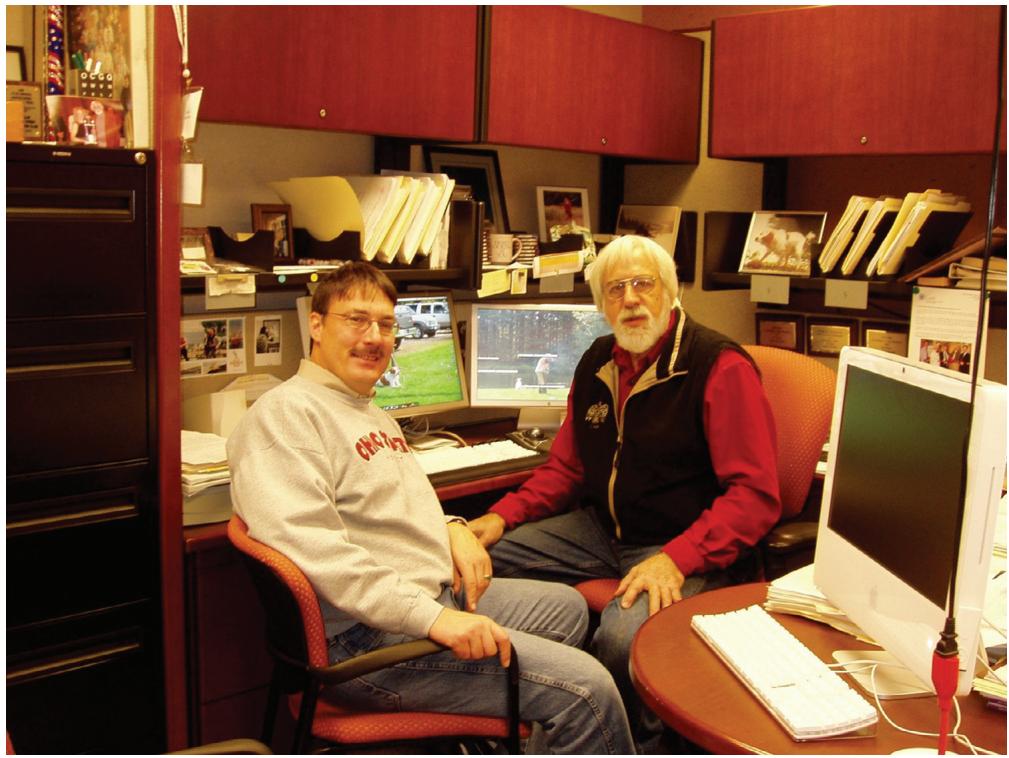
R.W. Hertle and L.F. Dell’Osso in the latter’s Daroff -Dell’Osso Ocular Motility Laboratory office.

foreword
A lot of intensely intelligent and highly dedicated workers have given their lives to this subject of nystagmus, and very little has come of it.
—Professor Frank A. Elliott , to R. B. Daroff (1965)
MY INTEREST in eye movements started on the first day of my neurology residency at Yale University, in July 1962, when we encountered a patient with a supranuclear ophthalmoplegia. Our att ending asked me to read about eye movements and give a report to the group. I spent the next 2 months reading all that I could fi nd on the subject and essentially became the Yale authority on eye movements while still only a PGY2. I decided to subspecialize in neuro-ophthalmology, a decision strengthened by a 3-month elective with J. Lawton Smith at the University of Miami during my PGY3 year.
I had an Army commitment after my residency and planned a neuro-ophthalmology fellowship thereaft er that involved nystagmus research using ocular muscle electromyography (EMG). I discussed these plans with Professor Frank Elliott , one of my University of Pennsylvania Medical School Neurology mentors, and his negative response appears above. Elliott was correct: in 1965, there was meager information about nystagmus, which my EMG plan wouldn’t have increased. I had been impressed by Goodwin Breinin’s ocular muscle EMG studies on gaze palsies, but except for convergence-retraction nystagmus, it has yielded no other useful information.
Fortunately, in the late 1960s and 1970s, several technologic advances led to enhanced understanding of eye movements in general and nystagmus in particular. As detailed by David Robinson, these included: the ability to record from single neurons in awake animals; the development of tracers to determine neuronal connections; computers that performed rapid data analysis; precise eye-movement recording techniques that noninvasively permitted minutes of arc measurements in all planes; and the popularization of a systems approach, where models provided the necessary hypotheses to focus basic and clinical research.
vii
Such advancements, particularly the last, resulted from the entry of biomedical engineers into eye-movement research. These included David Robinson and Lou Dell’Osso, along with their multiple trainees, whose collaborations with clinicians focused studies that addressed relevant clinical issues. The teams included David Robinson with Dave Zee and John Leigh; and Lou Dell’Osso with me, Todd Troost, John Flynn, and more recently with the pediatric neuro-ophthalmologist and surgeon, Richard Hertle. Dell’Osso’s own congenital nystagmus (now designated “infantile nystagmus syndrome”) naturally sparked his interest in understanding this previously understudied area.
Dell’Osso and Hertle described the book’s organization in their Preface. I can only add that it is authoritative, reader friendly, and, indeed, brilliantly constructed. Nystagmus in Infancy and Childhood will now serve as the definitive source for the understanding and treatment of previously ill-understood and untreatable eye-movement disorders.
Robert B. Daroff , MD
Professor and Chair Emeritus of
Neurology , Case Western Reserve
University School of Medicine viii • FOREWORD
preface
Never write about nystagmus, it will lead you nowhere.
—Hermann Wilbrand (1851–1953) to Robert Wartenberg (1886–1956) in 1921
THIS BOOK describes, illustrates, and shares our current understanding, evaluation, and treatments of nystagmus in infancy and childhood. It has been over five decades since the pioneering works Ocular Vertical Deviations and Nystagmus by J. Ringland Anderson and Clinical Methods of Neuro-Ophthalmologic Examination by Alfred Kestenbaum described what was known about ocular oscillations and what could be accomplished to treat those disorders. Since then the amount of knowledge regarding the anatomy, physiology, molecular biology, and types of investigation techniques and treatment options for nystagmus have exponentially increased. We believe this work is timely, aligning it with advanced concepts of developmental brain-eye diseases and summarizing novel treatment paradigms. By using this medium to consolidate our combined experience, the authors hope to provide a comprehensive resource for both clinicians and scientists who care for infants and children with nystagmus.
This text will provide clinicians with algorithms for examination; descriptions of diagnostic techniques; and medical, surgical, and alternative treatments of the visual system in infants and children with nystagmus. Another important goal of this work is to provide scientists with details on methodologies of investigation, including analysis software, models of the ocular motor system, and current hypotheses on the pathophysiology of ocular motor oscillations. Modern media formats are included to visually illustrate the varied presentations of these disorders with their diagnostic electrophysiology.
The roots of this monograph are deep, stemming from seeds planted in a lecture, “Nistagmo Infantile” presented to Il Gruppo Italiano per lo Studio del Movimento Oculare, III Incontro Nazionale, I Corso di Aggiornamento Teorico- Pratico in Alghero (Sardinia) Italy in 1989. There, thanks to Dr. Sebastiano Traccis’ invitation to LFD to speak at this meeting and Dr. Josephine Shallo-Hoff mann’s suggestion that a compilation of this information would be appreciated by clinicians treating these conditions, he began to collate ocular motor research about “congenital nystagmus,” “latent/manifest latent nystagmus,” the nystagmus blockage syndrome, and “spasmus nutans” with the aim of defi ning the critical factors in the differential diagnosis and treatment of these specific but easily confused types of nystagmus.
Clearly, the lure of new research kept this book on the back burner until the unbounded energy of Rich Hertle was applied to it. In the more than two decades that have elapsed since that first draft, not only has our knowledge base expanded tremendously but also the terminology has changed. In this handbook, we use the more modern CEMAS nomenclature and thereby avoid the misconceptions and errors inherent in the classical terminology. Eye-movement data and their analyses provide unambiguous, accurate, and repeatable waveform criteria and characteristics for infantile nystagmus syndrome, fusion maldevelopment nystagmus syndrome, nystagmus blockage syndrome, and spasmus nutans syndrome, allowing definitive diagnoses and determination of both the type and amount of the most efficacious therapy for each patient.
The resources used in this work include a summary (review) of much of the current knowledge regarding nystagmus in infancy and childhood, but, in addition, and uniquely, shares the authors’ combined 75 years of experience in studying, diagnosing, and treating thousands of patients with nystagmus. The book is structured in a logical way to allow a full cover-to-cover read or as a reference resource for those interested in a particular topic (e.g., eye-movement recording techniques, medical treatments, video appearance of periodic alternating nystagmus, etc.). Although one may concentrate on either the research or the clinical sections, the well-rounded reader would be better served by including both; they have been inseparable in our research approach and neither the “basic” nor the “clinical” aspects would exist without the other. We have included appendices that can be used in isolation for special purposes such as clinical examination sheets, patient information sheets, algorithm for computer analysis of nystagmus waveforms, and so on. Additional resources—including patient, waveform, and canine videos—can be found on the companion website for this volume. Please visit www.oup. com/us/nystagmus for crucial tools and information for clinicians and scientists.