I would encourage every IOL surgeon to make use of this authoritative, open access resource. Because the need to be proficient with phacoemulsifi cation and IOL designs seems foremost, many surgeons have neglected to invest much time, study, or interest in IOL power calculations. As I noted earlier, this is ironic because the most common reason that patients are unhappy with flawless cataract surgery is that they don’t see well without glasses. That so many patients now pay a premium for better refractive out comes makes mastery of IOL power calculations more important than ever.
My own career has given me the context to truly appreciate the signifi cance of modern biometry and formulas. I performed nearly 20 intracapsular cataract extractions as a resident and prescribed aphakic spectacles and con tact lenses. Those experiences made our first posterior chamber IOL implan tations seem miraculous. Because we didn’t yet have biometry at our Veterans Administration Hospital, we gave most patients a 19.5 diopter IOL and raised or lowered the power based on the patient’s preoperative spectacle prescrip tion. For my first 15 years in practice (until commercial approval of optical biometry), I personally performed applanation A-scan biometry on every patient, knowing that I couldn’t trust my staff to avoid corneal compression. I dutifully optimized my personal A-constants with 2-variable formulas for which we manually entered data into a rudimentary software program.
So it is from this perspective that I’d like to salute the editors and authors of this textbook whose collective contributions have been no less important than our best surgical and IOL technologies in achieving patient satisfaction. These individuals who have quietly committed their efforts to the science and betterment of IOL power calculations are the unsung heroes of modern cata ract surgery. Remember this every time that your grateful cataract patients thank you because they are thrilled by how well they see without glasses.
References
Kane JX, Chang DF. Intraocular lens power formulas, biometry, and intra- operative aberrometry: a review. Ophthalmology. 2021;128:e94–e114.
Hoffer KJ. Mathematics and computers in intraocular lens calculation. J Cataract Refract Surg (AIOIS J). 1975;1(1):3.
Los Altos, CA, USA
David F. Chang
Preface
What started in 2005 as a chance meeting of four formula authors (Aramberri, Haigis, Hoffer and Olsen) immediately grew to six (Norrby and Shammas) and led to annual bicontinental meetings in unique settings that combined intense scientific discussion, great camaraderie and friendship and a powerful zeal to improve the accuracy of IOL power calculation. This subject can be intense and complicated and often not a pastime for most of the eye surgeons of the world, but the subject is the essence of successful cataract/IOL surgery for all of our patients.
The IOL Power Club (IPC) has considered several methods to foster dis semination of information to inform our colleagues of the best and most up- to-date methods to improve accuracy in IOL power calculation such as scientific meetings, IPC didactic courses at ASCRS and ESCRS and collab orative studies by international colleagues. It became obvious to us that it would be beneficial to produce a textbook covering every aspect of this sub ject from all experts in the field as well as industry which could be immedi ately available Open Access (free) to any eye surgeon anywhere in the world at the touch of a button.
We have to thank the many people who have aided us in our efforts over the years, especially the many colleagues that have contributed their time and ideas to our meetings, those who felt an obligation to sponsor our efforts, especially Jim Mazzo of AMO/Zeiss who kept us going in the early days, Joerg Iwanczuk of Oculus who remained faithful and reminded us of our goals as well as the many corporate sponsors who have supported us, not only financially but by contributing pertinent scientific input and collaborattion.
We hope anyone interested in this subject or in need of information will find something of value and perhaps it will stimulate some to help contribute to this half-century goal of perfection in IOL power prediction.
Santa Monica, CA, USA
Kenneth J. Hoffer
Acknowledgments
By Kenneth J Hoffer MD FACS
In Memorium Wolfgang Haigis PhD at the IOL Power Club Scientific Meeting in Haarlem, Netherlands, in 2013 and singing on the train to Memphis, TN in 2012.
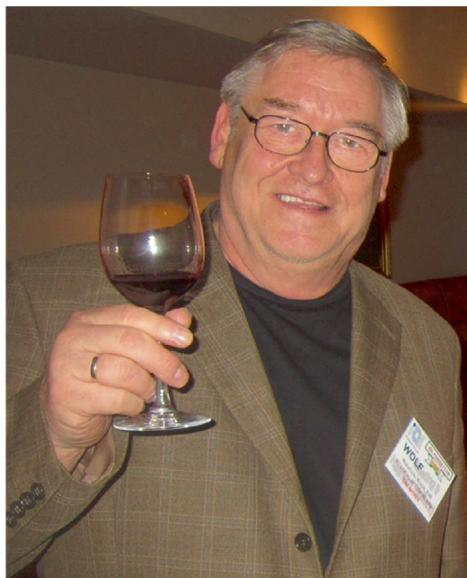

Wolfgang Haigis was born in Stuttgart, Germany on May 30, 1947. He attended Schillerschule in Stuttgart-Bad Cannstatt from 1954 to 1958 and Gottlieb-Daimler Gymnasium in the same city from 1958 to 1962. He then moved to Würzburg to attend High School at the Naturwissenschaftlich- Neusprachliches Röntgengymnasium from 1962 to 1967.
In 1968, he began his academic studies at the Julius-Maximilians- University in Würzburg receiving his PhD diploma on July 5, 1974. He began his work at the Eye Clinic at the University of Würzburg on June 1, 1977 and received a promotion at the university on July 19, 1980. He became a Professor of Ophthalmology at the university’s eye department.
Few knew that when Wolf was a student and also at the beginning of his career, he worked as a DJ in a disco in the little village of Eibelstadt just outside Würzburg (Photo: Wolff singing on the train from Chicago to Memphis in 2012 during the IPC Meeting). He was very popular, especially with the girls.
Wolf married Katharina Haigis on May 8, 1987. Katrine still works as a lawyer in a small law office in Hassfurt (her birthplace) practicing family and criminal law.
Wolf, as a physicist, began working on immersion ultrasound measure ments of the eye prior to cataract surgery at the clinic. When he was approached in the mid-1990s by Carl Zeiss Meditech to help them set up the first optical biometer (the IOLMaster), he recognized that the instrument results for axial eye length had to match that of immersion ultrasound to allow its use with conventional formulas. His concept worked smoothly and led to the IOLMaster becoming the Gold Standard for biometry. All subse quent optical biometers followed his standard.
Wolf gave over 490 lectures on these subjects all over the world and put on over 158 courses, many at the European Society of Cataract and Refractive Surgery (ESCRS) meetings and of the latter he was most proud of them. He was the author of 188 scientific publications. He was a found ing member of Technology in Medicine and Healthcare (TIMUG) and in 2009 was awarded the first Science Prize by the German-speaking Society for Intraocular Lens Implantation, Interventional and Refractive Surgery (DGII). He was inducted as a member of the International Intraocular Implant Club (IIIC) in 2008.
Because there was a need for cataract/IOL surgeons to have access to the latest intraocular lens (IOL) constants when calculating IOL powers, in October 1999, Wolf set up a website with these values that he personally calculated from series of cases sent to him by surgeons from around the world. He called the site the ULIB (User Group for Laser Interference Biometry), and it became used by all surgeons and manufacturers around the world. He did this for no financial reward.
In 2000, he published his formula for IOL power which eschewed the use of corneal power, replacing it with preoperative anterior chamber depth and using three lens constants. The results using his formula have been excellent over these past 20 years. He also developed the Haigis L formula for calcula tions in eyes that have had previous laser refractive surgery which has also been very successful.